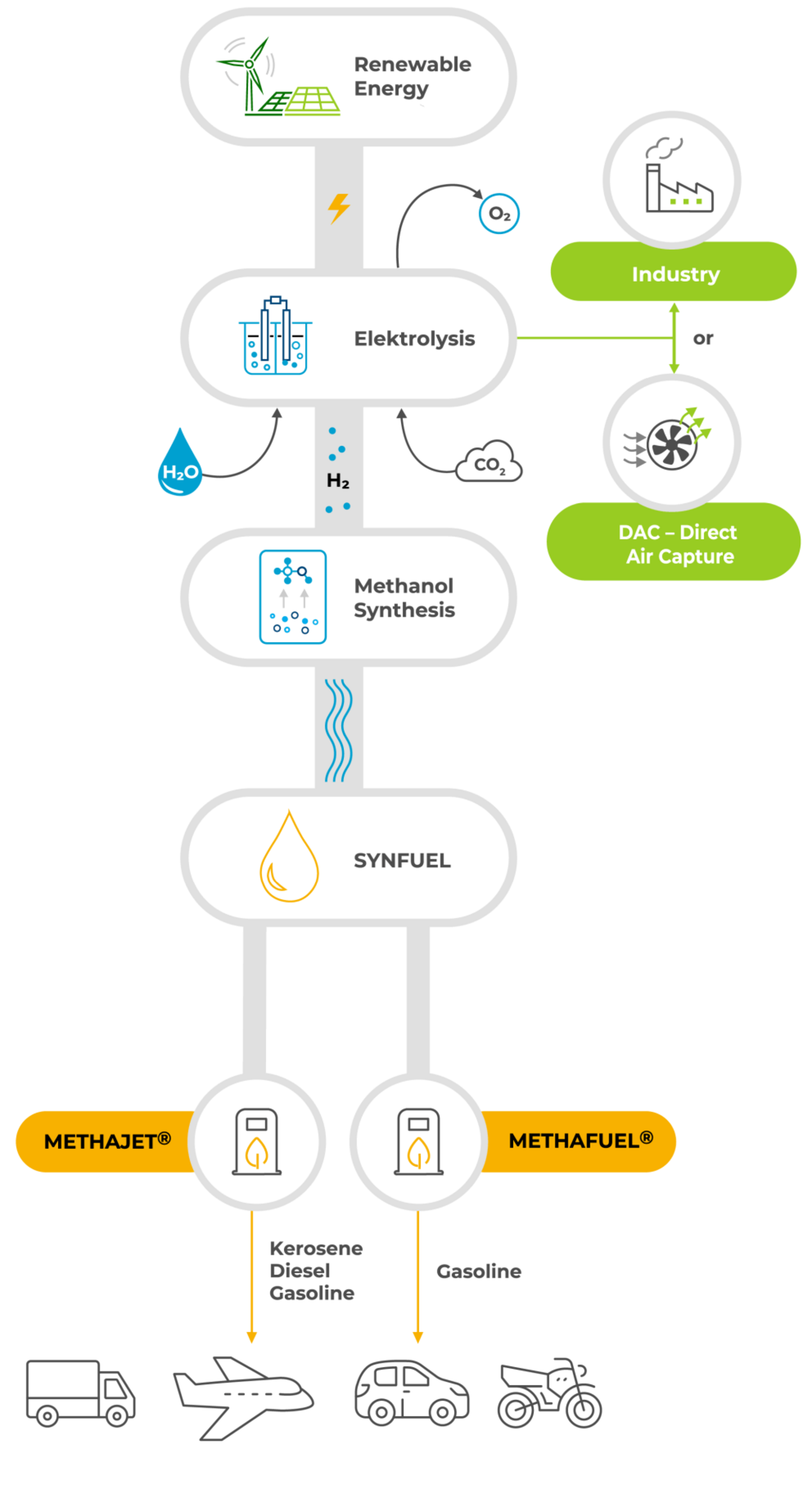
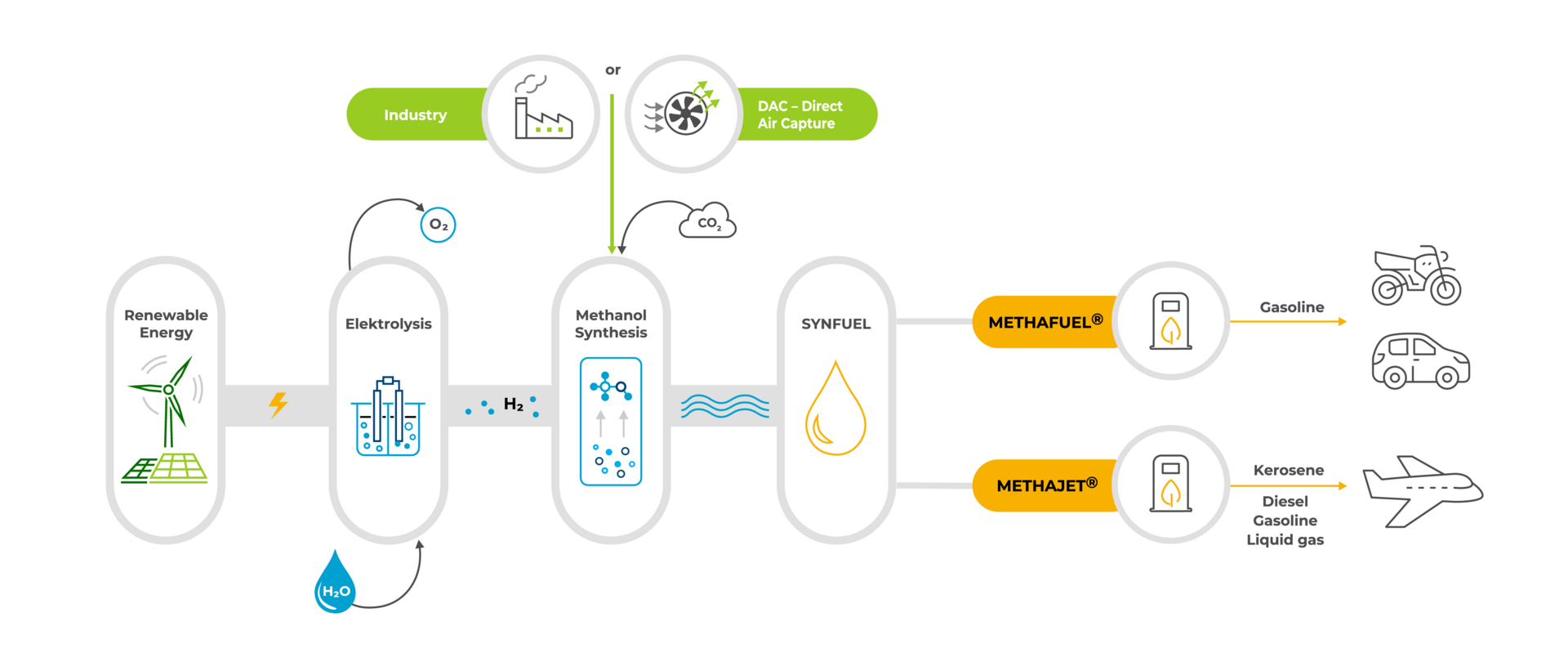

Electricity-based fuels - also known as e-fuels - are liquid, synthetic fuels. They are produced using green electricity from hydrogen and carbon dioxide. E-fuels are climate neutral, as they only release the same amount of CO2 that is taken from the atmosphere or from industrial source during their production.
E-fuels have the same chemical characteristics as standard (fossil) liquid fuels. For this reason, they are easy to transport and store. They also have a high energy density. These properties enable the economical import of renewable energy from areas of the world with ample sun and wind to Germany in the form of e-fuels or intermediate products. The import, storage and supply infrastructure required for this is already in place.
In 2015, the signatories to the Paris Climate Agreement committed to limiting human-induced global warming to well below 2 °C (compared to pre-industrial levels) and to pursuing efforts to limit the temperature increase to 1.5 °C. To this end, both Germany and the European Union intend to In 2015, the signatory states of the Paris Climate Agreement committed to limiting global warming to well below 2 °C compared to pre-industrial levels and to making efforts to limit the temperature increase to 1.5 °C. To achieve these goals, the European Union aims to reduce its net greenhouse gas emissions by at least 55% by 2030 compared to 1990 levels. Germany has even set itself the goal of reducing its greenhouse gas emissions by at least 65% over the same period. Many climate protection measures also contribute to improving air quality and thus quality of life.
Scientific analyses show that these climate goals are fundamentally achievable if the expansion of renewable energy is consistently pursued and innovative technologies are deployed on a large scale. The transportation sector plays a particularly important role in this regard: it accounts for around 25% of greenhouse gas emissions in the European Union and about 22% in Germany. In addition to the growing electrification of road transport, further solutions are needed to address, in particular, applications that cannot be electrified directly—or can only be done so with great difficulty. At the same time, the global fleet of more than one billion passenger cars must be gradually made more climate-friendly.
This is where synthetic fuels, known as e-fuels, come into play. They are produced using renewable energy, water, and CO₂, and can be distributed through the existing fuel infrastructure. For consumers, this means that existing vehicles with internal combustion or hybrid engines can generally continue to be used, and more climate-friendly fuel alternatives can be obtained through established distribution channels. The technologies required for the production of e-fuels are available and are already being used in plants. Implementation of these technologies on an industrial scale can begin immediately but requires investment certainty through, for example, policy decisions to support further investment in production capacity, renewable energy, and the necessary infrastructure.
- E-fuels / synthetic fuels are climate neutral.
- E-fuels have the same characteristics as conventional fossil fuels.
- In the long term, vehicles with internal combustion engines will continue to be on the road in Germany and worldwide, regardless of the promotion of electromobility.
--> E-fuels are the short-term solution for sustainable mobility! - As a high-tech location, Germany can drive the further development of the internal combustion engine to achieve enduring increases in efficiency.
- Securing of jobs at car manufacturers and in the automotive sector.
- E-fuels can replace fossil fuel in several areas. This means that not only cars, but also trucks, aircraft, passenger and freight trains as well as ships can be powered by synthetic fuels.
- E-fuels are ideally suited to storing renewable energies (wind, solar).
- E-fuels are liquid energy carriers/storage media with a high energy density, making them easy to transport. This enables e-fuels to be produced at locations with favourable conditions for renewable energies (wind, solar), making it possible to transport them to Germany via existing transport routes and methods. In brief: e-fuels are ideal for importing renewable energy!
The technology required is already in place and can be implemented in industrial production plants straight away, enabling e-fuels to be manufactured in large quantities. The time from the beginning of planning work to the start of production of a chemical plant is typically three years, meaning that e-fuels can be produced in significant quantities from the middle of this decade.
Future areas of use for e-fuels are all areas in which a climate neutral internal combustion engine is desirable. First and foremost is the existing global passenger vehicle fleet of 1.3 billion cars. In addition to road traffic, the maritime and aviation sector will also be dependent on e-fuels, as so far, no (practicable and reliable) technical propulsion alternative exists for these forms of transport.
Provided that political acceptance and the corresponding will exist, it will initially make sense to blend e-fuels with standard fuels. In this case a few cents extra per litre will not make a significant difference. With the increasing number and capacity of production plants and the corresponding rise in the volume of e-fuelavailability, manufacturing costs benefit from economies of scale resulting from mass production, making e-fuels morefavourable. Subject to suitable production locations - dependent on a reasonably priced supply of renewable energy - current calculations for e-gasoline, for example, indicate possible manufacturing costs of below one euro per litre.
In 2008, a customer query laid the foundations for the development of gasoline synthesis technology. The aim was to convert the associated gas that emerges during the extraction of oil into a valuable liquid product capable of being transported over large distances. This enables remote sources of raw materials to be better connected to the areas in which they are required.
The idea received its technical implementation in a large demonstration plant of the Department of Energy Process Engineering and Chemical Engineering (IEC) at TU Bergakademie Freiberg. Construction of the plant began in March 2009, with commissioning in June 2010. In three years of research operation the process could be demonstrated successfully on a large scale, with over 100,000 litres of high-quality gasoline produced.


